
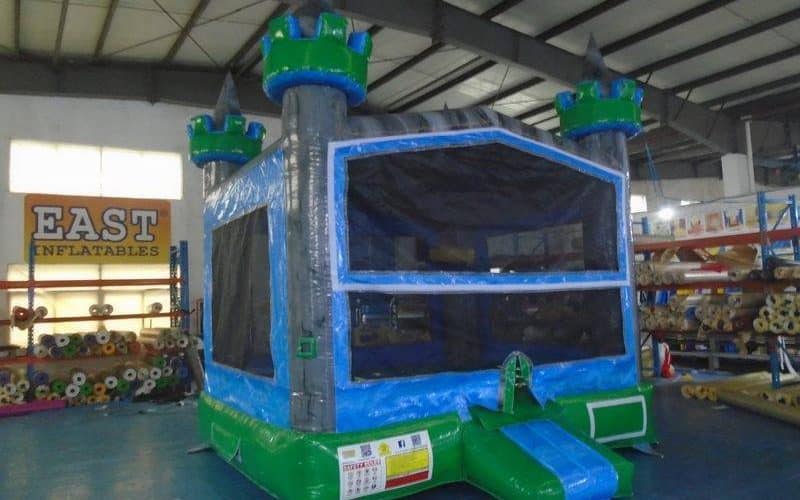
When setting up an inflatable, stability is your #1 priority. A bounce house that isn’t properly secured can become a serious hazard in even a light breeze. But exactly how many stakes does a bounce house need to be considered safe and stable?
The Golden Rule: One Stake Per Anchor Point
The industry standard is simple: You must use a stake for every single built-in anchor point provided by the manufacturer. Most standard residential bounce houses feature 4 to 6 anchor points, while larger commercial units or inflatable waterslides can have 8 to 15 points. If the manufacturer sewed a loop or a D-ring onto the base, it is there for a structural reason—never skip a single one.
3 Critical Factors for Inflatable Stability
1. Ground Type and Stake Specifications
The number of stakes matters, but the quality of the stake is what holds the unit down.
- Grass/Soil: Use heavy-duty steel stakes at least 12 to 18 inches long.
- Hard Surfaces: If you cannot use stakes (like on a driveway), you must use professional sandbags. A general rule is 50–75 lbs of weight per anchor point for small units, and significantly more for larger slides.
2. Wind Speed Safety Limits
No amount of stakes can overcome high winds. The ASTM (American Society for Testing and Materials) and safety organizations recommend deflating the unit immediately if winds exceed 15–20 mph. Stakes provide stability against jumping impact, but they cannot prevent an inflatable from acting like a giant sail in a storm.
3. The “45-Degree” Angle Technique
To get the most “grip” from your stakes, they should be driven into the ground at a 45-degree angle pointing away from the inflatable.
- Why? This creates the highest level of mechanical resistance. If you drive them straight down, they are much easier for the wind or jumping force to “pluck” out of the dirt.
Safety Checklist Before You Let Kids Jump
- Inspect the Loops: Ensure no anchor loops are frayed, ripped, or showing signs of “stress whitening.”
- Flush to Ground: The head of the stake should be flush with the grass to prevent it from becoming a tripping hazard or a projectile.
- The “Tug Test”: Give every tether a firm pull. If the stake wiggles in loose soil, you may need longer stakes or a secondary anchoring method.
Expert Warning: Never substitute specialized inflatable stakes with “camping tent pegs.” Tent pegs are too thin and short; they lack the surface area required to hold a pressurized inflatable in place during active play.
Final Thoughts
Stability isn’t just about the number of stakes—it’s about the integrity of the entire setup. By using every anchor point and the correct 45-degree technique, you ensure a safe, worry-free environment for everyone.
Always refer to your specific model’s owner manual, as safety standards may vary by unit size and height.